Showing posts with label Miscellaneous. Show all posts

Thursday, 29 December 2011

THE DENTISTS ACT, 1948

THE DENTISTS ACT, 1948

(16 OF 1948)

(As modified up to the 1st July 1987)

[Subordinate legislation being published separately.]

GOVERNMENT OF INDIA
Ministry of Law and Justice

  
For Downloading Complete Act CLICK HERE

Sunday, 2 October 2011

Tooth Discoloration Caused By Acne Treatment in Teens


Tetracycline Stain on Teeth
Tetracycline Discoloration
Every dentist is familiar with tetracycline staining and the damaging effect it has on tooth color and the self-esteem of the patient. I was under the belief that this phenomenon was something that affected my baby boomer patients, and was no longer an ongoing phenomenon, I was wrong. Many of our teenage patients, one of my children included, are being treated for acne with antibiotics in the Tetracycline family. These medications, in particular Minocycline, are associated with tooth discoloration. The change in color is in an increase in chroma and greying. A study done at the University of North Carolina showed the effect of Minocycline in causing tooth discoloration even in adults.
What should we know so that we can support our patients who are actively being treated by a dermatologist for acne. The incidence of tooth discoloration appears to be related to dose and the length of time the patient is on the medication. The risk increases the higher the dose and the longer the patient is keep on the antibiotic. There is some evidence that taking vitamin C in high doses at the same time as the Minocycline can reduce the risk of tooth discoloration. Conventional therapies like in office and tray bleaching at home can mitigate the effects of the tooth discoloration. There may be some benefit to utilizing trays and a limited regimen of whitening during the course of the antibiotics to prevent darkening of the teeth. Some patients may require restorative alternatives if the discoloration is severe.
The psychological cost of having acne as a teenager can be high, what we don;t want is to exchange that for the psychological cost of a lifetime of discolored teeth. At a minimum record the shade of the teeth prior to the onset of treatment so that you can monitor for any change and then advise the dermatologist if the teeth begin to darken. If the color change is caught early, the medication protocol can be changed, and tooth whitening can be initiated. I have added this as a question on my medical history, so we can open the conversation about acne therapy with our patients, and reached out to the local dermatology offices with whom I have mutual patients, so we can partner together.

Friday, 30 September 2011

Tokyo dentist makes your teeth look worse


Japanese yaeba teethIn Japan, crooked teeth are sometimes a sign that you might have ¥30,000 to spare.
Tourists come to Asia from all over the world to take advantage of affordable and top-quality cosmetic and plastic surgery procedures.
But a new fad in Japan has us wondering how many people will be flying in for supplemental dental work that promises to make teeth appear crooked.
Perhaps your folks spent thousands on fixing your wonky teeth all those years ago.
But chances are, if you were born in Japan, it was more like zero -- the lack of orthodontists is one reason why having a mouth full of straight teeth isn’t such a big deal here.
In fact, in some circles that goofy look is downright desirable, which leads us to the news that a Ginza-based dental clinic has just started supplying fake crooked teeth to those blessed with more traditionally “beautiful” pearly whites.

Grin and bare it

Dental Salon Plaisir says its Tsuke-yaeba -- or Stick-on Crooked Teeth -- will impart that desirable “imperfect” look to men and women alike, making them more attractive to the opposite sex.
The theory behind that slightly odd approach is that classic beauty tends to scare away timid suitors, whereas a more down-home look is easily approachable.
Similarly, some Japanese women have been reported to favor men wearing glasses, as the physical flaw has a comparable aphrodisiac effect.
Anyone seeking Tsuke-yaeba will need to fork out upwards of ¥30,000 ($390) and undergo a short procedure as a Plaisir dentist applies the plastic gnashers with glue. Naturally, they’re color-matched to your real teeth.

Here today ...

As for the advisability of the process, Tokyo orthodontist Masaru Iwatsuki has his doubts. “It’s a crazy idea,” he says. “Teeth have holes to let oxygen in. Covering them is bad for the tooth’s health.”
“Not that it matters, though,” he reckons. “It’s clearly a passing fad -- something that will be gone in six months.”


Read more: Tokyo dental fad? Make your teeth look worse | CNNGo.com http://www.cnngo.com/tokyo/life/tokyo-dentist-offers-make-your-teeth-look-worse-035816#ixzz1ZQg6f5GZ

Saturday, 24 September 2011

Dental or Surgical Loupes ? The Basics, Advantages and Benefits.

You can buy Dental loupes online  from http://www.phillips-safety.com
Dental loupes are a kind of Dental equipment used for magnification of operating field. These are nothing but a pair of magnifying glasses. As dentists use there both hands while working so these loupes are binoculars and comes in the form of glasses. Dentists usually put it on while working. Sometime loupes are fitted with light sources which are usually LED with fiber optic cables. Loupes increase the magnification of the field and hence helps in better diagnosis and precise work, while a dentists performs his work at millimeter level this kind of magnification can help him to improve the quality of treatment.Now a days loupe mounted cameras and video recorders are also available.


Benefits of using Dental Loupes 

1.In Dental Procedure-After using loupes the magnification can increase upto 2.5x- 6x which will dramatically improve the visibility of the field and hence it will improve our preciseness of the treatments.Better results and lesser failures will give us more patient satisfaction & ease of working.

2.Correct Posture and ease of work- Dentist have unusual sitting position while working and extended hours of work will reasult in strain in eye, muscles and tendons, resulting in permanent damage in long term.
dental loupeshow does loupes help-


  • Reduced eye, neck and back fatigue


  • Enhanced view of your instruments


  • Better visualization of the oral cavity

  • Increased patient confidence and satisfaction


How to chose a loupe for you:
The first factor to consider is the working distance that you feel comfortable working at. For example, a person who is 5′ 6″ tall is going to have a shorter working distance than someone who is 6’6″ tall. You need to find the optimal distance away from the patient you prefer to work at.After finding a suitable ergonomic position, you simply take a tape measure and measure the distance between your eyes and the patient.The depth of field is the next factor to consider. The depth of field is another way of saying the safe viewing distance that the loupes will remain in focus. Which means you will be able to move closer and further away from the patient without your loupes losing focus.
There is a wide variety when it comes to magnification level of your loupes, with levels ranging from 2.5x magnification all the way up to 6.0x magnification for most standard surgical and dental loupes. When starting out with your first pair of loupes it is typically suggested to start with a low magnification such as a 2.5x or 3.0x since adjusting to loupes is easier if the magnification is lower.
Credits -

Posted by Dr. Paresh Soni
You can read the original article at his blog here

Thursday, 22 September 2011

How to Put on Surgical Gloves


 15 videos 
119,027 
   
Uploaded by  on Nov 11, 2007
How to put on sterile gloves.

gical Gloves


Open the inner glove wrapper Pick up the first glove by the cuff While holding the cuff, slip your other hand into the glove Pick up the second glove by sliding the fingers of the gloved hand under the cuff Put the second glove on the ungloved hand by maintaining a steady pull through the cuff

Preparation for putting on surgical gloves
Gloves are cuffed to make it easier to put them on without contaminating them. When putting on sterile gloves, remember that the first glove should be picked up by the cuff only. The second glove should then be touched only by the other sterile glove.
Step 1
Prepare a large, clean, dry area for opening the package of gloves. Either open the outer glove package and then perform a surgical scrub or perform a surgical scrub and ask someone else to open the package of gloves for you.
Step 2
Open the inner glove wrapper, exposing the cuffed gloves with the palms up.
Step 3
Pick up the first glove by the cuff, touching only the inside portion of the cuff (the inside is the side that will be touching your skin when the glove is on).
Step 4
While holding the cuff in one hand, slip your other hand into the glove. (Pointing the fingers of the glove toward the floor will keep the fingers open.) Be careful not to touch anything, and hold the gloves above your waist level.
NOTE: If the first glove is not fitted correctly, wait to make any adjustment until the second glove is on. Then use the sterile fingers of one glove to adjust the sterile portion of the other glove.
Step 5
Pick up the second glove by sliding the fingers of the gloved hand under the cuff of the second glove. Be careful not to contaminate the gloved hand with the ungloved hand as the second glove is being put on.
Step 6
Put the second glove on the ungloved hand by maintaining a steady pull through the cuff.
Step 7
Adjust the glove fingers until the gloves fit comfortably.

Source- Endenger Health

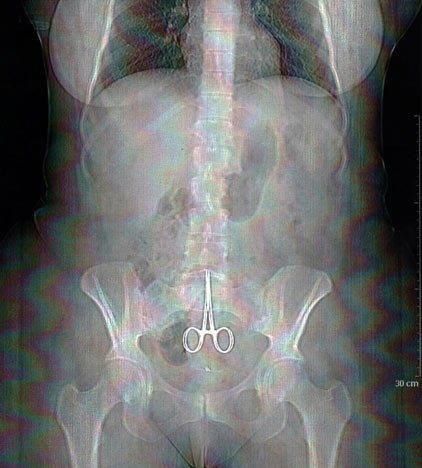
World's most shocking Radiographs

Six nails embedded in the skull of construction worker Isidro Mejia, 39, after an industrial incident caused a nail gun to shoot nails into his head and brain on April 19, 2004, are seen in this X-ray image from Providence Holy Cross Hospital in Los Angeles. Five of the six nails were removed in surgery that day and the sixth was removed from his face on April 23, after the swelling went down


This image provide by the University Medical Center in Tucson, Arizona shows the x-ray of an 86 year-old man, Leroy Luetscher, who was accidentally impaled through his eye socket with pruning shears at his home on July 30, 2011. While working in his yard, Luetscher dropped a pair of pruning shears, which landed in the ground point-side down. When Mr. Luetscher went to pick up the shears, he lost his balance and fell face-down on the handl


A x-ray made on February 13, 2011 in Lyon, shows a pair of surgical pliers in the abdomen of Anne, a women who complained of abdominal pain after a surgery. Six months after her surgical operation, Anne realized she had a pair of surgical pliers which had been forgotten in her womb, when the point of the pliers pierced her navel following a "good fit of coughing" on last february 11

A dentist, a model, and an actor !

Model and actor Rajeev Pillai is unhappy with the fact that Mollywood does not think him suited to the industry 

Rajeev Pillai exemplifies the fact that models in Kerala are not valued in their home grounds. A regular at the Lakme Fashion Week for the last three years, Rajeev can easily pass off for as an international model and break all misconceptions about Malayali males being genetically 'unfit.' "Getting there is not much of an effort, staying there is much more difficult, it requires determination, dedication and a lot more," says Rajeev about the proverbial six pack abs. "There are enough and more gyms and trainers of high standards in Kerala. A few months are all it takes to get into shape." At the same time, maintaining an optimum level of fitness is important for a model, he points out, as designers want a lean and fit look, not a muscle man. 

All that hard work obviously paid off, for Rajeev was asked to walk the ramp for the highly acclaimed Couture Fashion Week as well. He is now a known face in the Malayalam movie industry and has played villain in movies like 'City of God' and 'London Dreams,' 'Bombay March 12' and can be seen in 'Thejabhai and Family' as well. But Rajeev says somehow the industry is reluctant to cast him, their reasoning being that he is not suited for Malayalam. "While in Mumbai, I had done courses in acting and theatre. I still prefer to act. Modelling is a career with a very short life." However, Rajeev will always have an alternative career to fall back upon, for he is a qualified dentist, quite unusual for a model and actor. 

Rajeev is not at all happy with the way the Fashion Week is conducted in Kochi. Very few models in Kerala are fit to compete with those in other cities, but at the same time, the pay for models here is pathetic, he says. The only people who made money out of the Kochi Fashion Week are those who conducted it.


Source- Times Of India

Sunday, 11 September 2011

MHA (Masters Of Health Administration) after BDS


The Master of Health Administration (or Master of Healthcare Administration) is a masters- level professional degree granted to students who complete a course of study in the knowledge and competencies needed for careers in healthcare administration, involving the management of hospitals and other health services organizations. Programs can differ according to setting; although practitioner- teacher model programs are typically found in colleges of medicine or allied health, classroom-based programs can be found in colleges of business or public health.

1. Tata Institute of Social Sciences (Mumbai)

The Master of Health Administration and Master of Hospital Administration programmes aim to develop a cadre of professional managers in the health sector. Both these programmes are offered by the School of Health Systems Studies. Each semester involves taught courses, an internship, and/or a research project (optional for M.H.A. [Hospital]). The M.H.A. (Health) programme prepares students to take on managerial positions in the national health programmes and NGO sector community-based health programmes by building capacities in planning, implementing, monitoring and evaluating those programmes. It also orients the students to macro issues relevant to health policy and programming in the country. The M.H.A. (Hospital) programme prepares students for leadership roles in the hospital sector through training in planning, operational and project management of hospitals including orientation in the managerial aspects of clinical and support services departments. The programme also imparts training in managing financial, material and human resources as well as planning and managing information systems.  


2. Apollo Institute of Hospital Administration (Hyderabad)


3. Institute of Health Management Research (Jaipur)

The Institute offers a two-year full-time Postgraduate Programme with specialization in Hospital Management and Health Management. It is a flag ship educational programme aiming at developing trained professional managers with requisite skills in planning and operating management techniques; diagnosing and solving management problems; and acquiring consultancy skills, with a view to preparing them to manage hospitals and pharmaceutical and healthcare institutions in developing countries both in the public and the private sectors, and to meet the rising demand for quality care. For practical training the Institute has collaborative arrangements with multi-specialty hospitals and several pharmaceutical companies, NGOs and healthcare organizations. As the programme has set high standards of management education in the health sector, it has attained the status of a premier programme in the country. Our students go for training and placement to as many as one hundred hospitals and pharmaceutical and healthcare organizations.
  

4. Administrative Staff College of India (Hyderabad)

The ASCI Post Graduate Diploma in Hospital Management is a two-year residential full time Programme offered by ASCI and recognized by AICTE. The Programme comprises four semesters, three semesters of residential training followed by one semester of internship training.


5. Institute of Management Studies (Indore)

The MBA (Hospital Administration) programme :

  • Encourages active participation in case discussions, seminars, role-playing, management games and symposia.
  • Facilitates the students with 'Summer Trainings' in various hospitals and health care units at the culmination of each academic year, as an integral part of the academic schedule.
  • Incorporates a large number of library research assignments and presentations in all courses of functional area specialization.

Website -  http://www.ims.edu/